
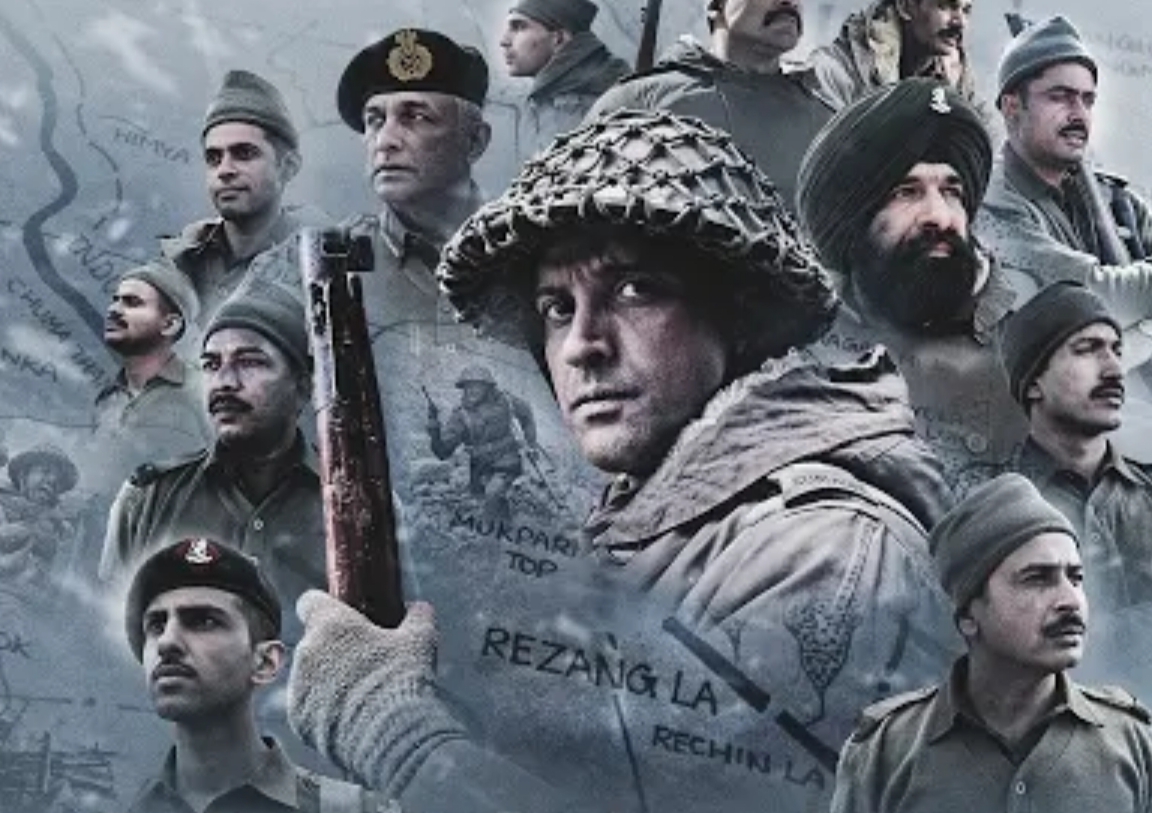
‘120 Bahadur’:Razneesh Ghai’s elegant homage to the steely defiance and bravery of our soldiers combines technical mastery with emotional weight.
Bollywood mostly keeps quiet about our conflicts and skirmishes with our northern neighbor, much like our political leadership. This week is a glorious exception, as director Razneesh Razy Ghai brings us back to the battle of Rezang La, where 120 Indian heroes from the plains foiled the dragon’s plans to take over all of Ladakh on Chushul Airfield on November 21, 1962, during the Sino-Indian War.

In 120 Bahadur, which is set on the 63rd anniversary of the battle, the Chinese army was forced to declare a unilateral ceasefire due to the Charlie Company of the Kumaon Regiment, under the command of Major Shaitan Singh Bhati (Farhan Akhtar). Even though India lost the war, the military tenacity displayed at Rezang La continues to be a source of pride for the country. The soldiers made a valiant last stand, fighting hand-to-hand and to their last man and bullet, defying orders to flee.
‘120 Bahadur’ (Hindi)
Director: Razneesh Ghai
Cast: Farhan Akhtar, Ajinkya Deo, Eijaz Khan, Rashii Khanna, Vivan Bhatena, Ankit Siwach.
Duration: 137 minutes
Storyline: Based on the real story of the 120 valiant troops of Charlie Company, under the command of Major Shaitan Singh, who, during the 1962 Sino-Indian War, made a fabled last stand at the icy Rezang La pass to stop Chinese aggression.
120 Bahadur is a genuine, technically sound tribute that gives both heart and mind their due on the battlefield, in contrast to the generic, chest-thumping, jingoistic celebrations of military milestones that Bollywood produces. Without diluting the specifics of the military maneuver in a harsh setting, it aligns the beats, attitude, and swagger that are very much of today.
More significantly, it highlights the diverse social makeup of our armed forces, which is something that mainstream cinema either ignores or only partially depicts. Ahir soldiers from the plains of Rajasthan and Haryana fought in the conflict. As Shaitan Singh states in the movie, these sons of farmers had grown up hearing tales of their fathers battling to protect their territories. Without being didactic, the movie conveys their resolve and sense of purpose.

With the war cry Dada Kishan Ki Jai resonating through the sociopolitical chambers, Shaitan Singh transforms the Ahirs’ grit and love for the motherland and Lord Krishna into a ferocious force, which explains why the colonial masters saw them as an indisciplined lot despite their exploits in world wars. Ahirs regard master strategist Krishna as their ancestor (dada) because they think they are descended from him.
The film’s signals are not superficial, as it is told in flashback mode through the voice of a friendly radio operator who changes during the battle. The movie is set during a period when Ahirs and Yadavs are calling for a separate regiment along the lines of Sikh and Jat formations as well as acknowledgment for their contributions, though this is not part of the story.
Shaitan Singh has resonance in the Gurjar belts, where Bhati is a common surname, even though Bhati is a Rajput. It illustrates how one could fight for a national cause while remaining loyal to their caste identity. A singing Dahiya and a chocolate-loving Yadav are among the soldiers. The screen is filled with the exuberant youthful energy.