


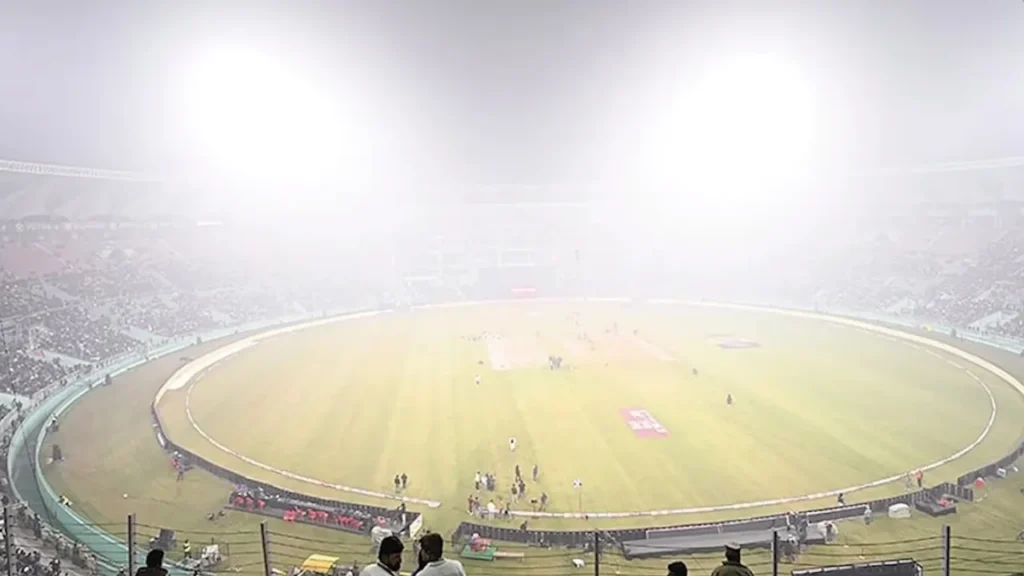
Indian cricket witnessed an unprecedented and embarrassing episode on Wednesday as the India Vs South Africa 4th T20I in Lucknow was abandoned without a single ball being bowled. Officially, the match was called off due to excessive fog, but the real issue went far beyond visibility concerns. A hazardous Air Quality Index (AQI) of over 400, combined with dense smog, raised serious questions about the Board of Control for Cricket in India’s (BCCI) planning, scheduling, and commitment to player welfare.
The abandonment not only disappointed fans who turned up at the Ekana Stadium but also exposed flaws in how international fixtures are scheduled in northern India during peak winter months.
India Vs South Africa 4th T20I Abandoned: What Really Happened in Lucknow
The fourth T20I between India Vs South Africa was scheduled to begin at 7 PM at the Ekana Cricket Stadium, Lucknow. However, a thick layer of smog had already enveloped the venue well before the toss.
Despite multiple inspections—at least six in total—the umpires found conditions unsuitable for play due to severely reduced visibility. The Air Quality Index remained in the hazardous category throughout the evening, making it unsafe for players and officials to take the field.
Star all-rounder Hardik Pandya was even spotted wearing a surgical mask during the Indian team’s warm-up session, underlining the seriousness of the pollution problem.
By 7:30 PM, players from both teams abandoned their warm-up routines and retreated to the dressing rooms. As the night progressed and visibility worsened, hope of a start faded. Eventually, at 9:30 PM, the match was officially abandoned—more as a formality than a surprise.
Hazardous AQI Overshadows India Vs South Africa Contest
While “excessive fog” was cited as the official reason, the reality was that a dense blanket of smog made play impossible. The AQI reading above 400 in Lucknow highlighted the dangerous air conditions under which an international match had been scheduled.
The sizeable crowd that braved the cold weather began leaving the stadium by 9 PM, frustrated by the uncertainty and lack of action. For a high-profile India Vs South Africa clash, the abandonment without a single delivery bowled was a major letdown.
How BCCI’s Scheduling Created a Mess
The abandoned T20I has brought the BCCI’s scheduling decisions under scrutiny. The venues chosen for the full India Vs South Africa series—across Tests, ODIs, and T20Is—included cities such as New Chandigarh, Dharamsala, Lucknow, Ranchi, Raipur, Visakhapatnam, Cuttack, Ahmedabad, Guwahati, and Kolkata during November and December.
This period is notorious for poor weather and high pollution levels in several north Indian cities. Locations like Lucknow, New Chandigarh, and Dharamsala often experience severe air quality issues and cold conditions during winter, making them risky choices for evening matches.
The Lucknow abandonment has highlighted how these predictable seasonal challenges were seemingly overlooked.
BCCI’s Response After India Vs South Africa Match Abandonment
During one of the inspections, BCCI vice-president and Uttar Pradesh Cricket Association strongman Rajeev Shukla walked out to the middle. After speaking with match officials, his body language reflected clear disappointment as conditions refused to improve.
With no reserve day scheduled for the match, both teams were left with no option but to move on. India and South Africa are now set to fly to Ahmedabad for the final T20I, with India leading the series 2-1.
How BCCI Could Have Avoided the India Vs South Africa Fiasco
The situation could have been handled better with smarter planning. While the BCCI follows a rotational policy for allotting venues, there was room for flexibility.
One possible solution could have been swapping venues with the white-ball series against New Zealand, scheduled to begin on January 11. That series is set to be played largely across western and southern India, including Vadodara, Rajkot, Indore, Nagpur, Raipur, Visakhapatnam, and Thiruvananthapuram, with only one match in Guwahati.
Such a swap might have reduced the risk of pollution- and fog-related disruptions during the India Vs South Africa series.
Winter Conditions Continue to Trouble North-Zone Venues
The Lucknow abandonment was not an isolated issue. Just a week earlier, the third T20I of the series was played in Dharamsala under extremely cold conditions, with temperatures dipping below 10 degrees Celsius.
After that match, India’s mystery spinner Varun Chakravarthy admitted he struggled with the conditions.
“I’ve never played at a ground this cold, so I did find it quite challenging,” he said.
On that day, the AQI in Dharamsala was in the ‘poor’ category. During the second T20I in New Chandigarh, air quality had even entered the ‘severe’ zone.
Questions Over BCCI’s Planning and Player Welfare
The recurring issues during the India Vs South Africa series have sparked debate over whether the BCCI’s operations team adequately considered historical weather and pollution data while finalizing venues.
Even a contingency plan—such as starting matches earlier in the afternoon—might have ensured some cricket for fans and reduced health risks for players.
The Lucknow episode has reinforced concerns that insufficient planning left no Plan B when predictable winter conditions struck.