


As the Reserve Bank of India (RBI) readies itself for the crucial monetary policy announcement this Friday, the financial markets remain sharply divided on whether the central bank will opt for a rate cut or maintain the current policy stance. With India’s GDP delivering a robust 8.2% growth and inflation slipping to a multi-decade low, the RBI’s Monetary Policy Committee (MPC) faces one of its most finely balanced decisions in recent times.
The three-day MPC meeting, scheduled from December 3 to December 5, will culminate with RBI Governor Sanjay Malhotra revealing the final decision on Thursday. The conclusion is expected to influence lending rates, borrowing costs, liquidity circumstances and general market mood.
Rate Cut: Why Expectations Are High
Record-Low Inflation Boosts Case for Rate Reduction
Retail inflation, measured by the Consumer Price Index (CPI), has stayed below the government-mandated lower band of 2% for two consecutive months. In October, CPI inflation plunged to a historic low of 0.25%, driven by:
- GST rate cuts
- A favourable base effect
- Sharp fall in prices of fruits and vegetables
Economists highlighting the possibility of a rate cut argue that the subdued inflation provides the RBI with ample room for further easing.
Experts Predict A 25 bps Cut
Several analysts expect the central bank to revive its rate-easing cycle, which had delivered 100 bps of cumulative cuts since February last year before pausing in August.
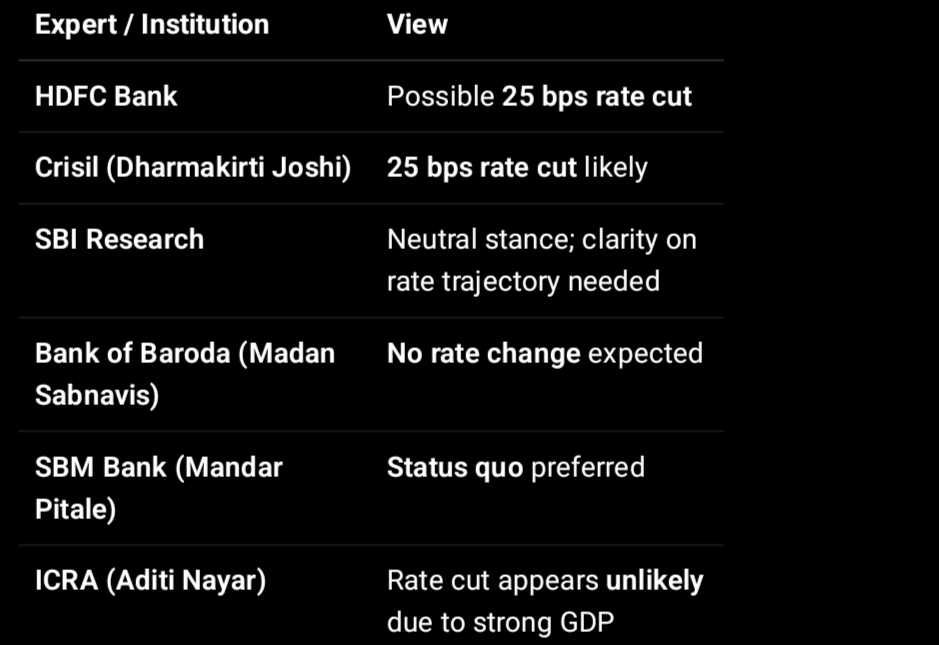
Crisil’s Chief Economist Dharmakirti Joshi noted that excluding gold, core inflation stands at 2.6%, also supported by GST cuts. He believes that the October inflation print has “created additional room” for monetary adjustment and forecasts a 25-basis-point rate cut in December.
A report from HDFC Bank echoes this sentiment, stating 2025 has been characterised by “growth overshooting and inflation undershooting,” leaving space for another cut.
Status Quo: Why Some Experts Prefer Caution
Strong GDP Growth May Encourage a Pause
Despite the inflation benefit, several economists predict the RBI may select status quo instead than a rate drop. India’s economy has posted an impressive 8.2% GDP growth in Q2, driven by:
- Fiscal consolidation
- Targeted public investment
- Implementation of reforms such as the GST rate cut
This stronger-than-expected growth may encourage the RBI to maintain stability, rather than opt for additional easing.
Policy Rate Already at “Fair Level”
Bank of Baroda’s Chief Economist Madan Sabnavis argues that the policy rate is well-aligned with future inflation projections. Inflation in Q4 FY26 and FY27 is expected to remain in the 4%+ zone, keeping the real repo rate between 1–1.5%, which he considers appropriate. Under such conditions, he believes no change is necessary.
Concerns Over Banking and BoP Flows
Mandar Pitale of SBM Bank (India) highlights other risk factors. He warns that a rate cut could:
- Redirect retail resources away from banks
- Affect the Balance of Payments (BoP)
- Disrupt interest-rate-sensitive capital flows
Hence, he expects the MPC to maintain the status quo for now.

RBI’s Guidance: Neutral to Dovish Tone Expected
Most analysts anticipate that the RBI’s forward guidance will lean neutral to dovish, indicating:
- Adequate liquidity support
- A cautious approach toward future policy easing
- Sensitivity to shifting growth-inflation dynamics
Even if the central bank maintains rates constant, the tone may still leave the door open for future rate decreases, depending on how growth and inflation go over the next quarter.